
Quick answer
A brochure is usually one folded sheet that sells a single thing quickly; a booklet is several sheets bound together, normally stapled, for content people keep and refer back to. At the time of writing, instantprint listed stapled booklets from £45.39 and folded leaflets from £21.83. Fit it on six panels, fold it; more, bind it.
The two words get used loosely, and plenty of printers call a stapled 12-page document a “brochure”. That is fine, as long as you know which format you are actually ordering. This guide sorts the formats by the job they do, sets out what each costs to produce and what changes in the artwork, and gives six common small-business jobs a clear answer. Third-party prices come from the printer’s own website at the time of writing, November 2026, and they change, so check before you order.
What printers mean by each word
In everyday UK print language there are three formats hiding behind two words:
- Folded leaflet. One sheet, printed both sides and folded. A half-fold gives four panels; a C-fold or Z-fold (both sold as tri-folds) gives six. Many businesses call this a brochure.
- Stapled booklet. Sheets folded in the middle and stapled along the spine, known as saddle stitching. Most printers also call this a brochure once it has a cover.
- Bound booklet. Pages glued into a square spine (perfect binding) or held with a wire coil. Used for catalogues, manuals and anything thick.
So the real question is not the word. It is whether your content fits on one folded sheet or needs pages, and how long you expect people to keep it.
Booklet vs brochure at a glance
| Question | Folded brochure (one sheet) | Booklet (bound pages) |
|---|---|---|
| Typical content | One service, one offer, one event | A full range, a menu of services, a guide |
| Panels or pages | 4 to 8 panels | 8 pages upwards, in multiples of four |
| How long it is kept | Read once, sometimes pinned up | Kept, passed round, referred back to |
| Starting price seen at instantprint | From £21.83 (half, C or Z fold) | From £45.39 (stapled) |
| Fits a DL envelope or rack | Yes, in DL folded size | Yes, if ordered in DL size |
| Design effort | Lower: one sheet, fold order to plan | Higher: spreads, page flow, cover |
How much content you have decides it
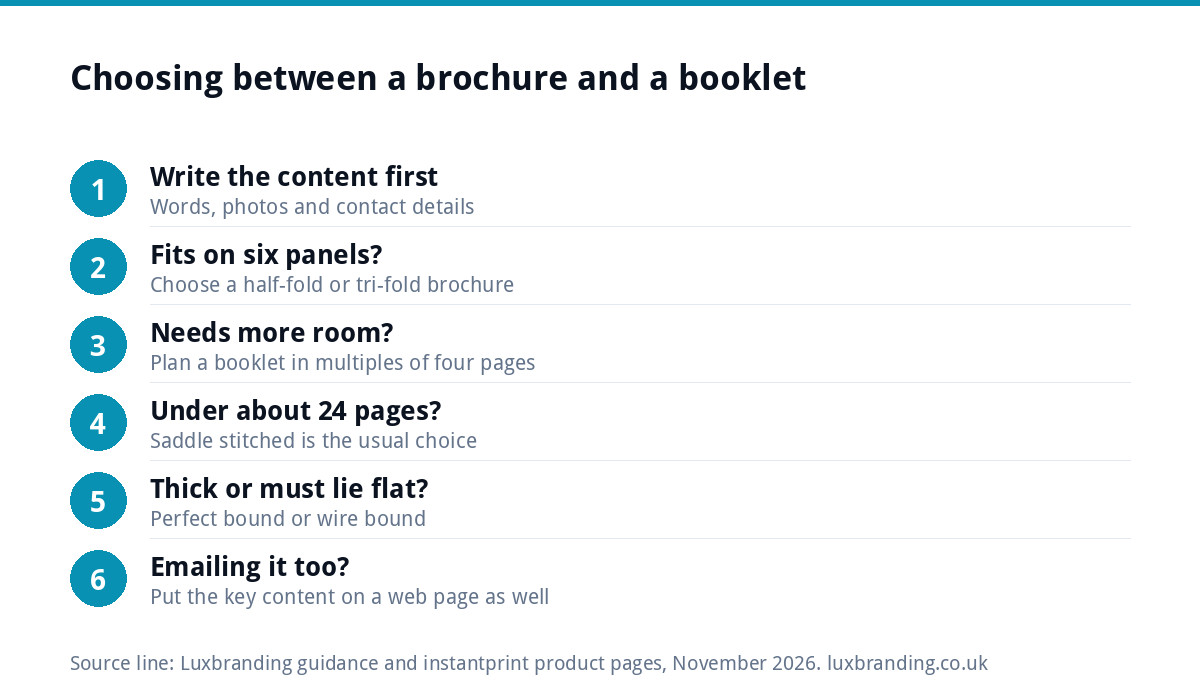
Write the words before you choose the format. A rough rule that works for most jobs: if the copy, photos and contact details fit comfortably on six panels without shrinking the type, a tri-fold brochure will do the job and cost less. If you are cramming, or if readers need to find a section rather than read top to bottom, you need pages.
Think about how it will be used, too. A leaflet handed over at a trade counter is skimmed in seconds. A welcome pack, a price guide or a product range is read at a table, sometimes more than once. Booklets earn their extra cost when people come back to them.
Page counts: why booklets come in fours
A stapled booklet is made from sheets folded in half, and each folded sheet gives four pages. That is why instantprint’s booklet page states that page counts for printing are in multiples of four. Eight, twelve, sixteen and twenty pages are all fine; ten is not. If your content runs to ten pages, either trim it to eight or plan two extra pages, for example a contents page and a contact page.
The cover counts as pages too. An eight-page booklet is the front cover, inside front, four inner pages, inside back and back cover. Plan the flat plan, a simple grid of every page, before anyone designs anything.
Binding options compared
The instantprint booklets page offers three bindings, and the differences matter more than the price:
| Binding | What it is | Good for | From (instantprint, at the time of writing) |
|---|---|---|---|
| Saddle stitched | Folded sheets stapled through the spine | Price guides, programmes, short catalogues | £45.39 |
| Wire bound | Pages held by a wire coil | Manuals and workbooks that must lie flat | £80.80 |
| Perfect bound | Pages glued to a square spine | Thick catalogues and brand books | £152.79 (32 to 300 pages) |
For most small businesses, saddle stitching is the sensible default. Perfect binding only becomes available at 32 pages on that printer, and it looks more like a book than a sales piece.
Six common jobs, sorted
- A single service or offer (boiler servicing, a spring clean deal): half-fold or tri-fold brochure.
- A price list for a salon or garage: tri-fold if it fits on six panels; an eight-page stapled booklet if it does not.
- A product range or trade catalogue: stapled booklet up to around 24 pages, perfect bound beyond that.
- An event or open day programme: an eight or twelve-page stapled booklet, so the schedule, map and sponsors each get room.
- A welcome pack for new customers: stapled booklet, because it is kept and referred to.
- A company profile for bigger clients: a short stapled booklet in print, with the same content as a PDF for email.
If you are torn, start with the folded format. It is cheaper to test, and if people keep asking for more detail, that tells you a booklet is worth it.
Paper, size and finish
Both formats come in the familiar sizes. instantprint lists booklets in A6, A5, A4, square and DL sizes, and its folded leaflets page offers half-fold, C-fold, Z-fold, roll-fold, cross-fold and concertina options across a similar range. A5 is the most comfortable size for a booklet held in one hand; DL suits racks, envelopes and van door pockets.
For a booklet, many businesses choose a heavier cover and lighter inner pages, which instantprint allows you to mix. A heavier cover survives being carried round; lighter inner pages keep the spine from cracking when folded. Ask for a sample pack if you cannot picture the weights.
Finish matters as well. A silk or gloss paper keeps photos of finished work sharp and bright, while an uncoated stock feels warmer and is easier to write on, which suits price lists that staff annotate by hand. If the brochure will sit in a van door or a toolbag for weeks, ask about a laminated cover. Whatever you choose, judge the colours on the actual paper, not on your screen.
Designing for the format
The two formats need different thinking at the design stage:
- Folded brochures are read in a sequence. The front panel sells, the first inside panel the reader sees must hook them, and the back panel carries contact details. On a C-fold, the panel that folds in is narrower so it tucks in cleanly; a template from your printer shows the exact widths.
- Booklets are read in spreads. Design left and right pages together, so photos and headings work across the pair.
- Allow for creep. In thicker stapled booklets the inner pages push outward slightly, so keep text and page numbers well inside the trim.
- Keep a safe area. Nothing important within a few millimetres of the trim or the fold, and bleed on every edge where colour runs off.
Our guide to print-ready artwork covers bleed, CMYK and fonts in more depth, and if a printer has already bounced your file, see what to do when a printer rejects artwork.
Plan the digital version too
Whichever you print, you will be asked to email it. A PDF of the print file is fine as a quick attachment, but the UK government’s guidance on publishing accessible documents is a useful reminder: PDFs often work poorly with screen readers, and it recommends offering an HTML version too. For a small business, that simply means putting the key content on a web page as well, and linking to the PDF from there.
Common mistakes
- Choosing the format before writing the content, then cramming or padding.
- A page count that is not a multiple of four, discovered after design.
- A tri-fold designed as three equal flat panels, which then will not fold neatly.
- Low-resolution logos and photos copied from a website. Logos should be vector files; see Recreate and Vectorise if you only have a JPG.
- No call to action: every format needs one clear next step, such as a phone number or web address.
Getting it designed
We design print but do not print it, so you can use whichever printer suits your budget. Our leaflet and flyer design covers folded formats, and if you already have artwork that needs preparing for press, our Print-Ready Artwork service is £49. For large-format pieces to sit alongside your brochure at events, poster and banner design is £89. If the brochure is part of a wider refresh, Brand Identity Design is £299 and sets the colours, typography and guidelines everything else follows. Every fixed price is on our pricing page.
Get the UK Print-Ready Artwork Checklist (free)
A one-page checklist for any UK designer or printer covering CMYK, bleed, fonts and resolution. Saves you the pre-press fix-up fees.
No spam. UK GDPR compliant. We only use your email to send this resource, unless you tick the box to hear from us.
Frequently asked questions
What is the difference between a booklet and a brochure? +
In UK print, a brochure usually means a single sheet folded into four or six panels, while a booklet is several sheets folded and bound, most often stapled along the spine. The words overlap, and many printers call a stapled booklet a brochure, so check the format and page count rather than the name when you order.
Why do booklets have to be in multiples of four pages? +
A stapled booklet is made from sheets folded in half, and each folded sheet creates four pages. That is why printers such as instantprint state that booklet page counts are in multiples of four. If your content runs to ten pages, trim it to eight or add two useful pages, such as contents and contact details.
Is a tri-fold brochure cheaper than a booklet? +
Usually, yes. At the time of writing, November 2026, instantprint listed half-fold, C-fold and Z-fold leaflets from £21.83 and stapled booklets from £45.39. Prices depend on quantity, size and paper, and they change, so compare like-for-like quotes for the same run before deciding on cost alone.
Which binding should a small business choose for a booklet? +
Saddle stitching, where folded sheets are stapled through the spine, suits most price guides, programmes and short catalogues and is the cheapest option. Wire binding lets a manual lie flat. Perfect binding gives a square, glued spine for thick catalogues, and instantprint offers it from 32 pages upwards.
Does Luxbranding print brochures and booklets? +
No. We design the artwork and supply print-ready files you can send to any printer you choose. Our Print-Ready Artwork service is £49 if you already have a design that needs preparing for press, and our leaflet and flyer design covers folded formats. You order the print directly from your chosen printer.


