
Quick answer
Ofcom’s Online Nation 2025 report found ChatGPT had 252 million UK web visits in August 2025, up 156% on a year earlier, while Google still handles about 3 billion UK searches a month. Around 30% of keyword searches now show Google’s AI Overviews, and 53% of UK people say they often see AI summaries.
This page gathers the public numbers on how AI is changing search in the UK, each with its source and date, and then explains what they mean for a small business that relies on being found online. Where a figure comes from the US rather than the UK, we say so.
Key statistics at a glance
| Statistic | Source, date |
|---|---|
| About 3 billion Google web searches a month from the UK | Ofcom Online Nation 2025, citing Similarweb, August 2025 |
| Google accounts for more than 90% of searches in the UK | Competition and Markets Authority, October 2025 |
| ChatGPT: 252 million UK web visits in August 2025, up 156% year on year | Ofcom Online Nation 2025 |
| ChatGPT: 1.8 billion UK visits in January to August 2025, up from 368 million in the same period of 2024 | Ofcom Online Nation 2025 |
| Around 30% of keyword searches show AI Overviews | Ofcom Online Nation 2025 |
| 53% of UK people say they often see AI summaries | Ofcom Online Nation 2025, citing YouGov, February 2025 |
| Search clicks fall 26% six months after a person first visits ChatGPT (US data) | Ofcom Online Nation 2025, citing Similarweb |
| 45% of consumers used AI for local business recommendations, up from 6% (US panel) | BrightLocal Local Consumer Review Survey 2026 |
Google is still the front door
For all the attention on AI chat tools, traditional search remains enormous. Ofcom’s Online Nation 2025 report puts Google at about 3 billion monthly web searches from the UK, citing Similarweb data for August 2025. Google Search was used by 82% of UK online adults in May 2025, according to the same report, down slightly from 83% in 2024 and 86% in 2023.
The Competition and Markets Authority, in its decision to designate Google with strategic market status in search in October 2025, said more than 90% of searches in the UK take place on Google’s platform.
The practical reading: for a UK small business, being found on Google is still the job. AI tools are an addition to that job, not a replacement for it.
How fast AI chat search is growing in the UK
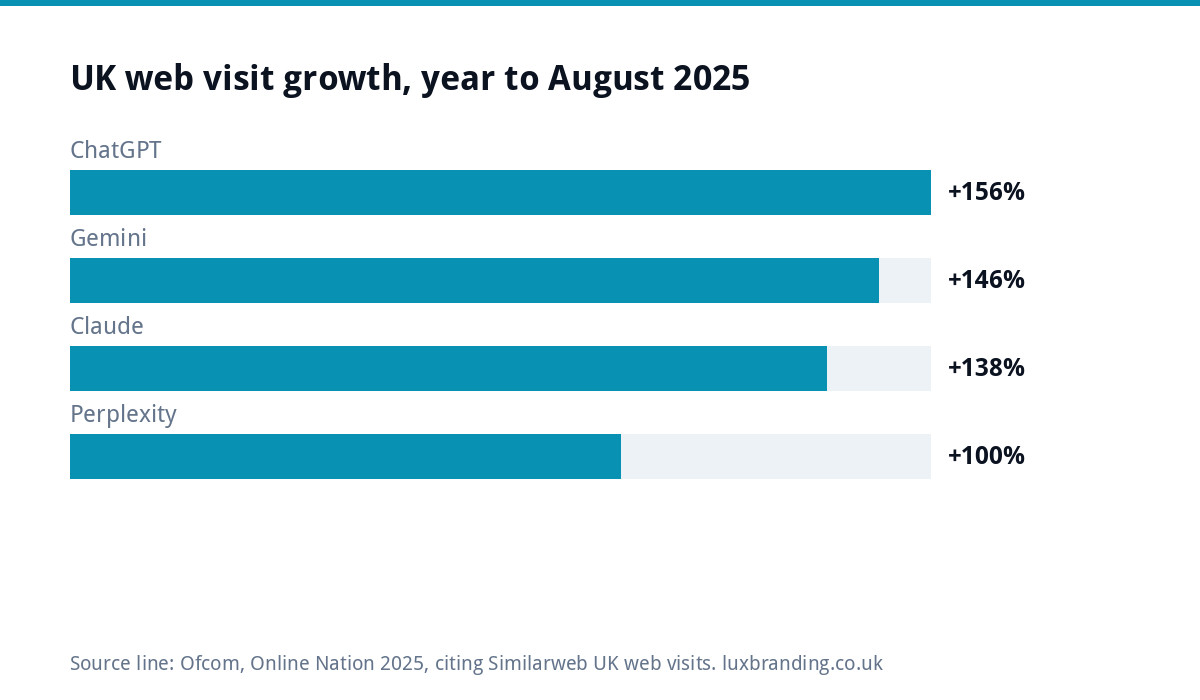
Ofcom describes ChatGPT as already the second-largest search service in the UK. The growth figures it reports for the year to August 2025 are steep:
- ChatGPT: 252 million UK web visits in August 2025, up 156% on the same month a year earlier.
- Gemini: up 146%.
- Claude: up 138%.
- Perplexity: up 100%.
Ofcom notes that Gemini, Claude and Perplexity grew from much smaller bases than ChatGPT. Over a longer window, ChatGPT had 1.8 billion UK visits in the first eight months of 2025, against 368 million in the same months of 2024. These are visits to the services, not searches, so they are not directly comparable with Google’s search count. A single visit to a chat tool can include several questions, and many of those questions are not searches at all: people also use these tools to write, plan and summarise.
AI Overviews: the answer on the results page
Most people meet AI in search without choosing to, through the summaries Google shows above its results. Ofcom reports that around 30% of keyword search queries now provide AI-supported overviews, and that up to 34% of non-branded searches include them. It cites YouGov research from February 2025 that 53% of UK people say they often see AI summaries.
Ofcom calls this “largely passive adoption”: people are using the same search engine as before and getting AI answers included. Google, for its part, said in a May 2025 announcement that AI Overviews were driving an increase of over 10% in usage of Google for the types of queries that show them, in the US and India, which it described as its biggest markets.
What AI answers do to clicks
The figures that matter most to website owners are about clicks, and the best available data here is from the US. Ofcom’s report cites three findings:
- Google users who saw an AI Overview were almost half as likely to click on links to other websites as users who did not (Pew Research Center, US, July 2025).
- Users who saw an AI Overview were more likely to end their browsing session entirely: 26% against 16% (Pew Research Center, US, July 2025).
- Six months after visiting ChatGPT for the first time, people’s Google search clicks were 26% lower (Similarweb, US).
These are US measurements, and the UK may differ. But the direction is consistent: when the answer appears on the page, fewer people visit the source. For a business, the click that remains is the one where the searcher wants to do something, such as book, buy or get a quote.
AI and local business recommendations
BrightLocal’s Local Consumer Review Survey 2026, published in February 2026, surveyed 1,002 US adult consumers. It is a US panel, so treat the numbers as a signal rather than a UK measurement. It found:
- Use of AI for local business recommendations rose from 6% the previous year to 45%, making it the third most popular source.
- Google’s share of use for evaluating local businesses dipped from 83% in 2025 to 71%.
- 40% of consumers trust AI platforms to provide business recommendations.
- 82% read AI-generated review summaries, and 23% would rely solely on those summaries to make a decision.
The last figure is worth dwelling on. If AI tools summarise your reviews, the content of those reviews, not just the star rating, shapes what a customer is told about you.
Where AI tools get their answers
AI answers are assembled from what is already published. Ofcom’s report notes that Reddit, which reached 60% of UK internet users in May 2025, was reported by Press Gazette as the most-cited source in Google’s AI Overviews and in Perplexity’s answers, and the second most-cited by ChatGPT. Reddit has agreed deals for its content to be used to train AI models.
For a small business the lesson is not “post on Reddit”. It is that AI tools lean on sources that are specific, detailed and written by people with real experience. Clear service pages, honest pricing information, detailed reviews and consistent business details across the web all give AI tools something accurate to repeat.
What the numbers mean for a UK small business
- Keep Google first. More than 90% of UK searches still happen there. If your site is not appearing, start with our guide to a website not showing on Google.
- Answer the question on your own page. Pages that state prices, areas covered and what is included are easier for both search engines and AI tools to quote accurately.
- Treat your Google Business Profile as a source. Accurate hours, services and categories feed both Maps and AI answers. Our Google Business Profile optimisation guide covers it.
- Earn detailed reviews. If AI summaries are read more than individual reviews, reviews that mention the job, the town and the outcome matter.
- Measure enquiries, not just traffic. Fewer clicks can still mean the same number of customers if the clicks that remain are ready to act.
Methodology and sources
Every figure on this page was read on the publisher’s own page or report in October 2026. Where a publisher cites another organisation’s data, we name both. We have not included any figures of our own.
| Source | Published | Coverage |
|---|---|---|
| Ofcom, Online Nation 2025 | 10 December 2025 (data May to August 2025) | UK, with some cited US studies |
| Competition and Markets Authority, search SMS decision | 10 October 2025 | UK |
| BrightLocal, Local Consumer Review Survey 2026 | 11 February 2026 | US panel of 1,002 adults |
| Google, Search blog | 20 May 2025 | US and India |
Getting found in search and AI answers
None of this requires a new kind of marketing. It requires doing the basics of search properly and keeping your information accurate everywhere. Our free SEO audit shows where your site stands. If you want help, our SEO service is £249 a month and covers rankings, content, technical health, link building and reports, and our content and blog writing service produces the detailed pages that both search engines and AI tools draw on. For context on budgets, see our guide to how much SEO costs in the UK, and every fixed price we offer is on our pricing page.
Get the UK SEO DIY Audit Checklist (free)
A 32-point checklist UK SMEs can run against their own website in an afternoon. Surfaces the quick wins before paying for a paid audit.
No spam. UK GDPR compliant. We only use your email to send this resource, unless you tick the box to hear from us.
Frequently asked questions
How many people in the UK use ChatGPT for search? +
Ofcom's Online Nation 2025 report does not give a user count, but it reports that ChatGPT had 252 million UK web visits in August 2025, up 156% on a year earlier, and 1.8 billion UK visits in the first eight months of 2025. Ofcom describes ChatGPT as already the second-largest search service in the UK.
Is Google still the main search engine in the UK? +
Yes. The Competition and Markets Authority said in October 2025 that more than 90% of UK searches take place on Google, and Ofcom puts Google at about 3 billion monthly UK web searches. Google Search was used by 82% of UK online adults in May 2025, according to Ofcom.
How often do Google AI Overviews appear? +
Ofcom's Online Nation 2025 report says around 30% of keyword search queries provide AI-supported overviews and up to 34% of non-branded searches include them. It cites YouGov research from February 2025 finding that 53% of UK people say they often see AI summaries in search.
Do AI Overviews reduce clicks to websites? +
The best available evidence is from the US. Ofcom cites Pew Research Center findings from July 2025 that Google users who saw an AI Overview were almost half as likely to click on links to other websites, and more likely to end their browsing session, at 26% against 16%.
Do people use AI to find local businesses? +
BrightLocal's Local Consumer Review Survey 2026, a US panel of 1,002 adults, found use of AI for local business recommendations rose from 6% to 45% in a year. It also found 82% read AI-generated review summaries. Equivalent UK figures were not available from a public source at the time of writing.