

Quick answer
A dofollow link is just a normal link that can pass ranking credit. A nofollow link carries rel=”nofollow” and asks Google not to count it, which Google now treats as a hint. Any link you pay for, even £20 for a directory listing, should be marked sponsored or nofollow, or it breaks Google’s spam policies.
“Nofollow” and “dofollow” come up whenever small business owners start looking at backlinks, directory listings or SEO offers. The terms sound technical, but the idea is simple, and getting it wrong can cost money or, in the worst case, rankings. This guide explains what the two mean, the newer link labels Google introduced, whether nofollow links are worth anything, and which links on your own site should carry the label.
What “dofollow” actually means
There is no such thing as a dofollow attribute. A “dofollow” link is simply an ordinary link with nothing added to it. Search engines treat ordinary links as a kind of recommendation, so a link from a respected site to yours can help your pages rank.
A nofollow link is a link with an extra instruction in its code: rel=”nofollow”. It still works for visitors exactly the same way. The difference is only in what it tells search engines: “do not treat this link as my endorsement”.
So when someone sells you “dofollow links”, they are selling ordinary links that pass ranking credit. As you will see below, that is exactly the kind Google says you must not buy.
The four rel values
Google’s guide to qualifying outbound links describes three labels you can add to a link, plus the default of adding nothing.
| Label | Google says use it for | Small business example |
|---|---|---|
| None (a normal link) | Links you editorially stand behind | Your link to a supplier you recommend |
| rel=”sponsored” | Advertisements or paid placements | A paid listing or a link in a sponsored post |
| rel=”ugc” | User-generated content such as comments and forum posts | Links in comments on your blog |
| rel=”nofollow” | When the other values do not apply | A link you need to include but do not want to vouch for |
Google says nofollow is still an acceptable way to flag paid links, though sponsored is preferred, and values can be combined, for example rel=”ugc nofollow”.
Nofollow became a hint in 2019
Nofollow used to be treated as a strict instruction. That changed in September 2019, when Google announced the sponsored and ugc labels. Its announcement, Evolving nofollow, explains that all of these link attributes are now treated as hints about which links to consider or exclude, and that nofollow became a hint for crawling and indexing purposes from 1 March 2020.
In plain terms: Google may now choose to take a nofollow link into account if it thinks the link is useful. The same post says there is no need to change any nofollow links you already have.
Do nofollow links have any value?
Yes, even if they pass little or no ranking credit. A nofollow link can still:
- Send real visitors. A link in a busy local news article or a well-read forum can bring enquiries directly.
- Get you found. Google may still discover your site through it, because a nofollow page can be crawled if found by other means.
- Build familiarity. Being mentioned in places your customers read builds trust, whatever the code says.
- Look natural. A real business picks up a mix of both kinds from directories, social profiles, reviews and press.
Judging a link opportunity only on whether it is “dofollow” misses most of the value. Ask instead whether your customers will see it, whether the site is relevant to your trade or area, and whether you would be happy for a customer to find you there.
Paid links: the rule that matters
This is the part with real consequences. Google’s spam policies list “buying or selling links for ranking purposes” and excessive link exchanges (“link to me and I’ll link to you”) as link spam. Paid links are fine when they are marked with nofollow or sponsored.
The same policies say sites that break the rules may rank lower or not appear in results at all. So if an SEO offer promises a bundle of “high authority dofollow backlinks” for a fee, you are being sold a breach of the rules with your website as the collateral. Our guide to what SEO costs in the UK explains what legitimate SEO spend looks like instead.
Which of your own links should be nofollow
Most links on your own site should be ordinary links. Labels are for specific situations.
| Link on your site | Label |
|---|---|
| Links between your own pages | None. Never nofollow your own internal links. |
| A supplier, trade body or accreditation you genuinely recommend | None |
| A partner who paid you, or gave you free goods, for the link | sponsored |
| Affiliate links that earn you commission | sponsored |
| Links left in blog comments or reviews | ugc (most platforms add this automatically) |
| A source you cite but do not want to vouch for | nofollow |
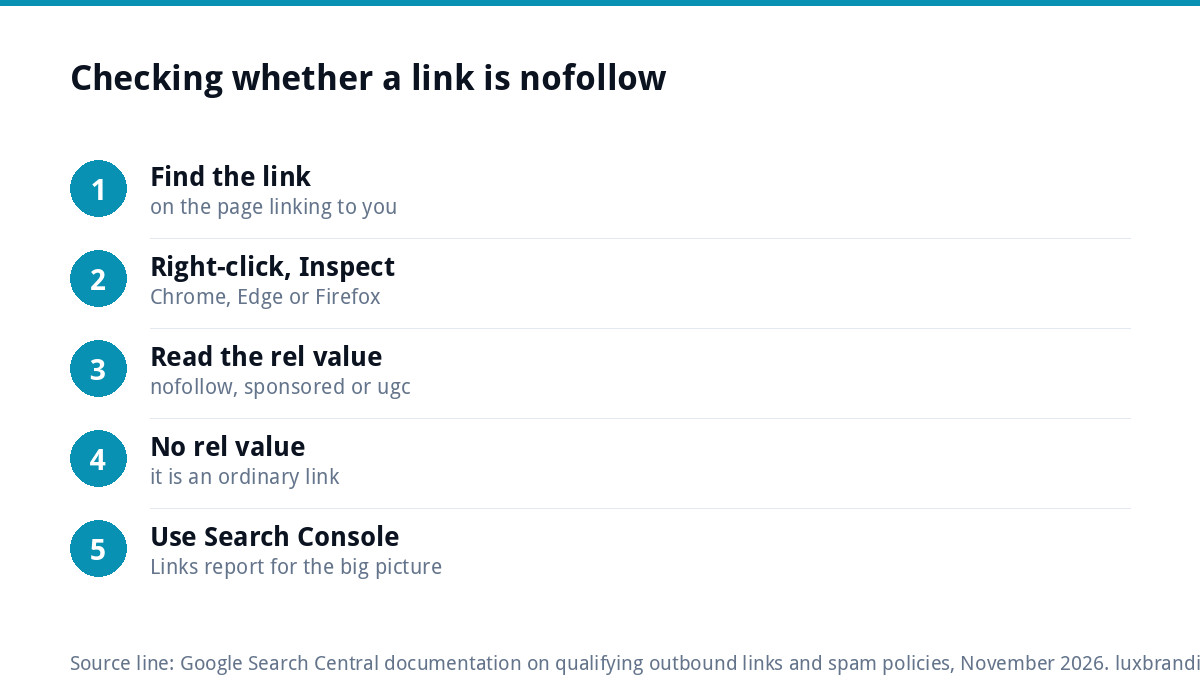
How to check whether a link is nofollow
- Find the link on the page that links to you.
- Right-click it and choose Inspect (in Chrome, Edge or Firefox).
- Look at the highlighted code. If you see rel=”nofollow”, rel=”sponsored” or rel=”ugc”, the link is labelled.
- If there is no rel value, or only values such as “noopener”, it is an ordinary link.
- Check your own links in Google Search Console. The Links report shows which sites link to you most, which is more useful than counting labels.
A worked example: a roofer’s links
Picture a roofing firm in Kent looking at the sites that link to it. The list includes its Google Business Profile and social pages, a handful of trade directories, a manufacturer’s approved installer page, the local chamber of commerce, a sponsored link from the junior football club whose kit it pays for, and a short article on a local news site about a church roof repair.
Several of those will be nofollow or sponsored: the social profiles, most directories, the football club and quite possibly the news article. That is normal and healthy. The manufacturer’s installer page and the chamber of commerce listing are probably ordinary links, and those two are likely to be the most valuable for rankings because they come from respected, relevant sites.
The firm then gets an email offering “20 high authority dofollow backlinks” for a monthly fee. Compared with what it already has, those links would add risk rather than value: they come from sites with no connection to roofing or Kent, and paying for them breaks Google’s rules. The better use of the money is another approved-installer listing, a genuine sponsorship and a few strong project pages on its own site.
Myths worth ignoring
- “Nofollow links are worthless.” They can send visitors and help discovery, as above.
- “You need a set ratio of dofollow to nofollow.” Google publishes no such ratio. Earn links naturally and the mix takes care of itself.
- “Nofollowing your own pages saves ranking power.” It does not help and can hide pages you want found.
- “Directory links are always dofollow gold.” Most directories add nofollow or sponsored, and only a handful are worth listing in for customers anyway.
What to focus on instead
For a local or trades business, the links that matter most are the ones you already deserve: suppliers and manufacturers you are approved by, trade bodies you belong to, local organisations you sponsor (labelled sponsored if they say so), and genuine press coverage of your work. Alongside that, make sure your own site is in good shape, because links cannot rescue pages Google cannot read.
Good links tend to follow good pages. A detailed page about a real job, with photos, the problem, the fix and the outcome, gives a supplier, a local paper or a community group something worth linking to. A thin page with three lines of text does not.
Our free SEO audit checks the technical basics, and our guide to a website not showing on Google covers the common causes.
Where we fit
Our SEO service is £249 a month and covers rankings, content, technical health, link building and reports, with links earned rather than bought. If you would like to know what an audit involves first, our guide to SEO audit costs sets it out. All our prices are on the pricing page; order online or email us at support@luxbranding.co.uk.
Get the UK SEO DIY Audit Checklist (free)
A 32-point checklist UK SMEs can run against their own website in an afternoon. Surfaces the quick wins before paying for a paid audit.
No spam. UK GDPR compliant. We only use your email to send this resource, unless you tick the box to hear from us.
Frequently asked questions
Are dofollow links better than nofollow links? +
For ranking credit, an ordinary followed link from a respected site usually counts for more. But nofollow links can still send visitors, help Google discover your pages and build familiarity with customers. Since 2019 Google treats nofollow as a hint, so it may take some into account. Judge a link by whether your customers will see it.
Is it against Google's rules to buy dofollow links? +
Yes. Google's spam policies list buying or selling links for ranking purposes as link spam. Paid links are allowed only when marked rel sponsored or rel nofollow. Sites that break the rules may rank lower or disappear from results, so treat any offer of paid dofollow backlinks as a risk to your website.
Should I make my internal links nofollow? +
No. Links between your own pages should be ordinary links, so search engines can find and understand every page. Nofollowing your own pages does not save ranking power and can hide pages you want found. Keep labels for paid, affiliate, user-generated or untrusted links pointing to other websites.
Do directory listings give dofollow links? +
Many do not. A lot of directories add nofollow or sponsored to business links, especially on paid listings. That is fine: a directory is worth being in if your customers use it, not because of the link code. Choose a handful of directories that matter in your trade and keep your details identical across them.
What is the difference between nofollow and sponsored? +
Sponsored is the label Google prefers for advertisements and paid placements. Nofollow is the general label for links you do not want to vouch for when no other label fits. Google still accepts nofollow on paid links, and you can combine values, for example sponsored and nofollow together, if you want to be doubly clear.


